
Maintenance Planner & Resource Leveling Excel Workbook
Determine if Your Maintenance Staffing is Sufficient
Accurately determining if your team has sufficient 'wrench-time' is a technical requirement for consistent plant reliability. Our capacity planning framework supports the analysis of labor vs. workload, helping you identify staffing gaps before they become an operational risk.
*See Professional Disclaimer regarding maintenance planning.
Staff Optimization
Identify if your technical team is over or under-utilized based on your actual PM task requirements.
Scenario Analysis
Evaluate the impact of changing maintenance intervals or staffing levels on your total available wrench-time.
Immediate Starting Point
Provides an organized Excel framework for workload analysis, eliminating the need to build a professional model from a blank page.
Achieve staff sufficiency, reduce downtime, and enhance efficiency with our Maintenance Staff Planner and Capacity Planner. Embrace success with meticulous organization, analysis, and planning.
 Now Accepting Apple Pay
Your purchase is securely processed by PayPal.
Delivered in minutes: How it works.
Flexible Planning for Any System
This tool is designed for any business that does any type of scheduled maintenance.
Already have a maintenance system? If so, there is a good chance the utility capability provided by our planning worksheet will still be of use. Your existing system may not support a view of your resources and tasks with endless what-if scenarios that our tool provides.
If you have a maintenance system where all information is entered manually (a paper system), then this tool will work for you as well. This planning worksheet is all about the task. How often you perform the task and the total budgeted time to perform the task. We just know you will get to see your scheduled work from a different perspective by using our worksheet tool.
- Focusing on task scheduling against critical systems and critical assets without being overwhelmed by data.
- Balancing annual preventive maintenance task scheduling against actual technician available wrench time based on goals, efficiency, staffing, holidays, etc.
- Pie chart representation of the annual hours resulting from your preventive maintenance task schedule on a critical system or critical asset.
- Clearly analyzing staffing parameters and maintenance task labor at an annual level to show insufficient or excess staffing.
The implementation of a successful maintenance program requires that the supervisor pay close attention to the preparatory steps. What are these steps? Successful implementation requires a plan for organizing the staff, identifying and prioritizing the equipment based on needs, documenting and estimating the time required to complete each task, and most importantly, establishing the frequency for how often the tasks are to be performed.
For those not possessing Microsoft Office or Microsoft Excel, both LibreOffice and Apache OpenOffice are excellent alternatives that are readily downloadable.
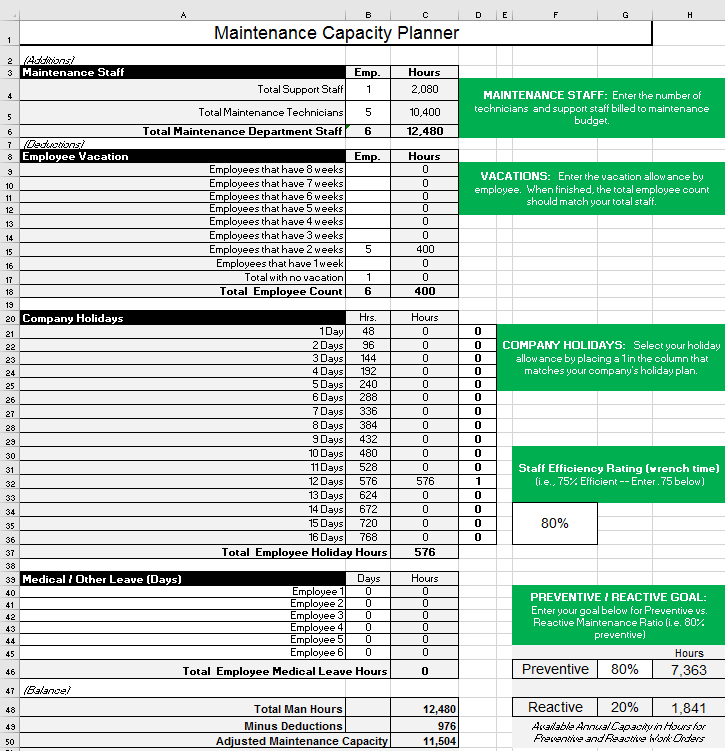
Organize, identify, and prioritize
Analyze your resources (ie: employees, vacation, holiday, sick leave, etc.) to ensure you have sufficient man-hours for your annual corrective and preventive maintenance.
Focus on a system, asset type, or task category within your organization to improve efficiency and ensure that preventive maintenance intervals are performed as required but not too often.
Benefits
- Ensure your staff numbers are adequate for scheduled preventive maintenance.
- Evaluate potential for staff downsizing.
- Avoid down-time from equipment failures resulting from incomplete scheduled maintenance due to staffing shortages.
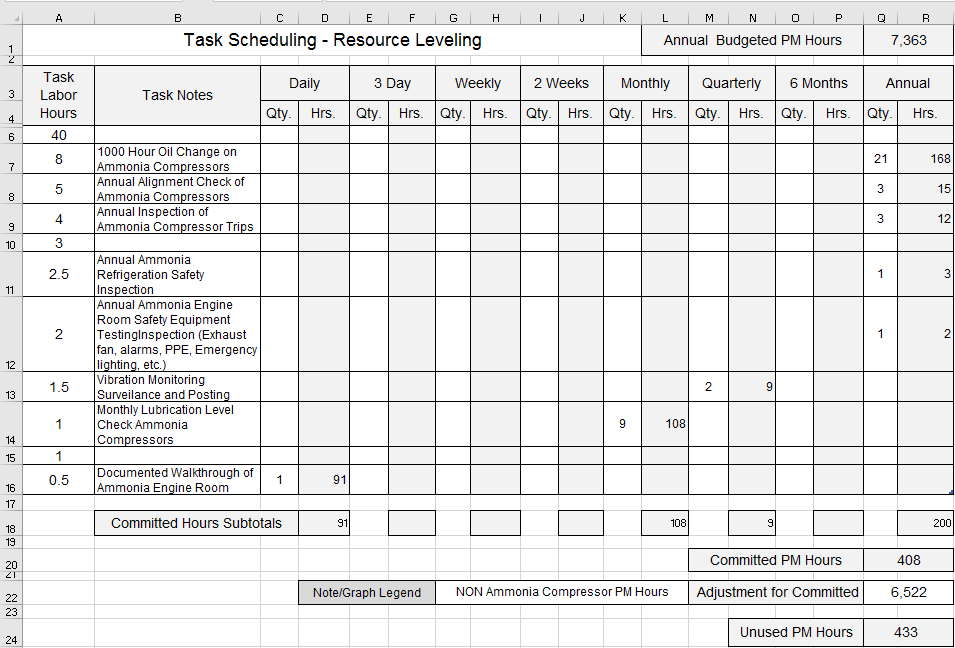
Task-Based Workload Analysis
How many tasks and how many times per year?
Target critical systems first and level resources.
Example
ABC Food Processing Management recognizes their ammonia refrigeration system is a critical resource and asks the maintenance supervisor to evaluate the scheduling efficiency of preventive maintenance within the system and also how it relates to the overall preventive maintenance budget.
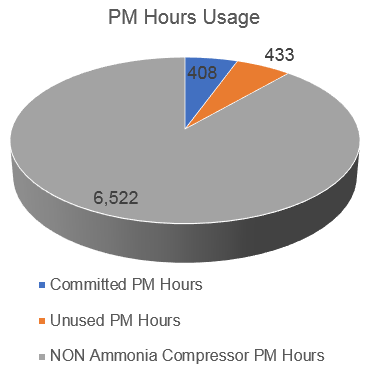
Focus on a critical system
continuing our example... Maintenance Supervisor, Bob Jordan, performs the following steps to target pm task scheduling efficiency on their ammonia system:
- Runs a report from their CMMS Software to generate the annual hours for ALL scheduled preventive maintenance EXCEPT "Ammonia System"
- Runs a report from their CMMS Software to generate an annual preventive maintenance tasks schedule FOR "Ammonia System".
- Having the above information in hand, Bob may evaluate the pm task scheduling efficiency of the ammonia system utilizing our Maintenance Capacity Planner.
Related Products & Included Offers

Mechanic's Mate CMMS for MS Windows
For those who need a complete maintenance management system, our Mechanic's Mate software for Windows provides a comprehensive solution beyond an Excel sheet.
Included Offer: PM Checklists Product
This Maintenance Planner is included for FREE when you purchase our comprehensive PM Checklists product, which contains an extensive library of maintenance tasks.
Maintenance Resources
Guides to Improving Maintenance Efficiency
HVAC Published Articles & White Papers
12 Best Practices of Inventory Optimization
What Hides Behind the Term: Lean Maintenance
Operations & Maintenance Best Practices - A Guide to Achieving Operational Efficiency
Guides to CMMS
ROI Calculator - Justifying the Cost of CMMS
The Business Case - Benefits of a CMMS