
Control Valve Noise Calculation Tool
Effective noise mitigation requires more than just an estimate. Our ISA/IEC-aligned framework supports the rigorous prediction of aerodynamic and hydrodynamic noise, helping your technical team identify safety and integrity risks before they become a permanent operational liability.
*See Professional Disclaimer regarding acoustic analysis and validation.
Standard Compliant
Calculations based on rigorous IEC 60534-8-3/4 and ISA-75.01.01 engineering methodologies.
Occupational Safety
Support hearing conservation programs and OSHA compliance with verifiable noise predictions.
Total Transparency
Open architecture Excel environment allows engineers to inspect and verify all calculation logic.
Support worker safety initiatives and regulatory compliance by analyzing aerodynamic and hydrodynamic noise with our open architecture Excel spreadsheets.
- View the calculation process and see exactly how noise levels are predicted.
- Understand control valve noise calculations with a transparent framework.
- Explore the underlying principles of aerodynamic and hydrodynamic noise.
Calculate Aerodynamic and Hydrodynamic Noise
Our tool uses established methodologies to calculate both aerodynamic and hydrodynamic noise levels in control valves. Input your process parameters and valve specifications to quickly determine noise levels and identify potential noise hazards.
IEC/ISA Compliance
This tool provides two sets of worksheets, one set complying with IEC 60534-8-3:2015 and ISA-75.01.01 standards and another set using the simplified non-IEC ABC Method. The ABC Method sacrifices some of the accuracy of the IEC method in the name of simplicity and ease of use. Also, the ABC Method may not fully account for nuances of specific valve designs or unusual operating conditions that the IEC standard may capture. It also has inherent limitations and only works within a range of conditions. Take advantage of both methods so you may meet regulatory requirements and industry best practices for noise control.
Open Architecture Excel Interface
Leveraging the familiarity of Excel, our tool provides a user-friendly interface for efficient noise calculations. Input parameters, view results, and generate reports with ease.
 Now Accepting Apple Pay
Your purchase is securely processed by PayPal.
Delivered in minutes: How it works.
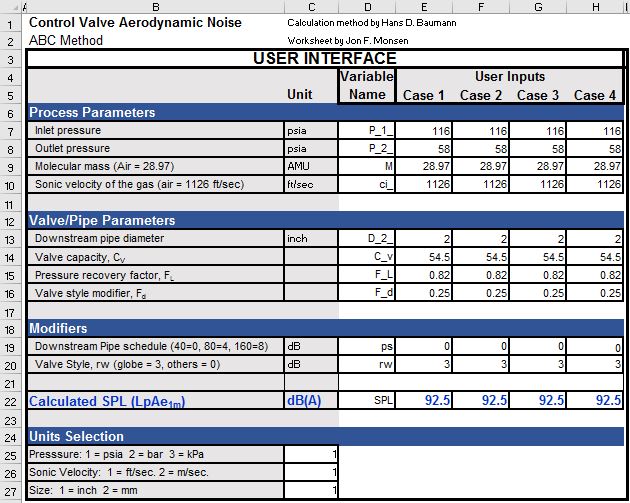
Here are some screenshots from the Control Valve Noise Calculation Tool
Key Features:
- Compliance with Established Industry Methodologies (including IEC 60534-8-3:2015 and ISA-75.01.01)
- User-friendly Excel interface
- Comprehensive documentation
Dive In - Get Hands-On With Noise Prediction:
- Understand the key factors that influence aerodynamic and hydrodynamic noise.
- Explore how different valve parameters affect noise levels.
- Experience noise calculations in action using a familiar Excel interface.
- Use real-world scenarios to see how the calculations come together to form noise predictions.
Benefits:
- Protect worker hearing and prevent noise-induced hearing loss
- Support compliance with workplace noise regulations (e.g., OSHA)
- Optimize control valve selection and design for quieter operation
- Reduce noise-related complaints and legal risks
- Improve worker productivity and morale
Open Architecture: To prevent accidental formula errors, worksheets are set to "Protected" by default. However, no password is required to unprotect them, giving you full control to inspect or modify the logic.
What you get with product purchase:
October 2022 Worksheet that predicts control valve aerodynamic noise.
- Control Valve Aerodynamic Noise - October 2022 Worksheet: Aerodynamic_Noise_ABC_CVAT.xlsx
- Associated article: Simple Excel worksheet predicts control valve aerodynamic noise (worksheet-predicts-aerodynamic-noise.pdf)
July 2022 Worksheet that predicts control valve hydrodynamic noise.
- Control Valve Hydrodynamic Noise - July 2022 Worksheet: Hydro_ABC_Enanced_CVAT.xlsx
- Associated article: Excel worksheet predicts control valve hydrodynamic noise (worksheet-predicts-hydrodynamic-noise.pdf)
IEC Control Valve Aerodynamic Noise Worksheets:
- IEC Aero Noise Mass: IEC_Aero_Noise_Mass_4C_R2.xlsx
- IEC Aero Noise Volumetric: IEC_Aero_Noise_Vol_4C_R2.xlsx
- Instructions: IEC_Aero_Noise_Instructions.pdf
IEC Control Valve Hydrodynamic Noise Worksheets:
- IEC Hydro Noise Mass: IEC_Hydro_Noise_Mass_4C_R1b.xlsx
- IEC Hydro Noise Volumetric: IEC_Hydro_Noise_Vol_4C_R1b.xlsx
- Typical xFz, Fd and FL for IEC Control Valve Calculations: IEC_xFz_Fd_FL_Noise_Calcs_R4.xlsx
- Instructions: IEC_Hydro_Noise_Instructions.pdf
Note: This tool is also included in the full feature Control Valve Sizing & Analysis Worksheets package.
Recommended Reading
Guide to Control Valves & Process Variability
Guide to Installed Gain | Control Valve Sizing
Control Valve Flow Characteristics
Converting a Non-Linear Valve Installed Flow Characteristic to a Linear Flow vs. Controller Output
Determining Gas Density Using the NIST Chemistry WebBook
Determining the Pressure Drop to be Used in a Control Valve Sizing Calculation
Installed Gain and Control Valve Selection
Installed Gain as a Control Valve Sizing Criterion
Keys to Effective Valve Sizing & Selection
Metso’s Nelprof® Helps Select a Pump for Optimum Control Valve Pressure Drop
Modern Tools for Sizing Control Valves and Actuators
Predicting Cavitation Damage in Control Valves
Rules of Thumb: Techniques and Considerations for Properly Sizing Control Valves
SteamTab Companion Free Windows App - Thermodynamic and Transport Properties of Water and Steam
Stop Cavitation From Destroying Your Control Valve Trims